


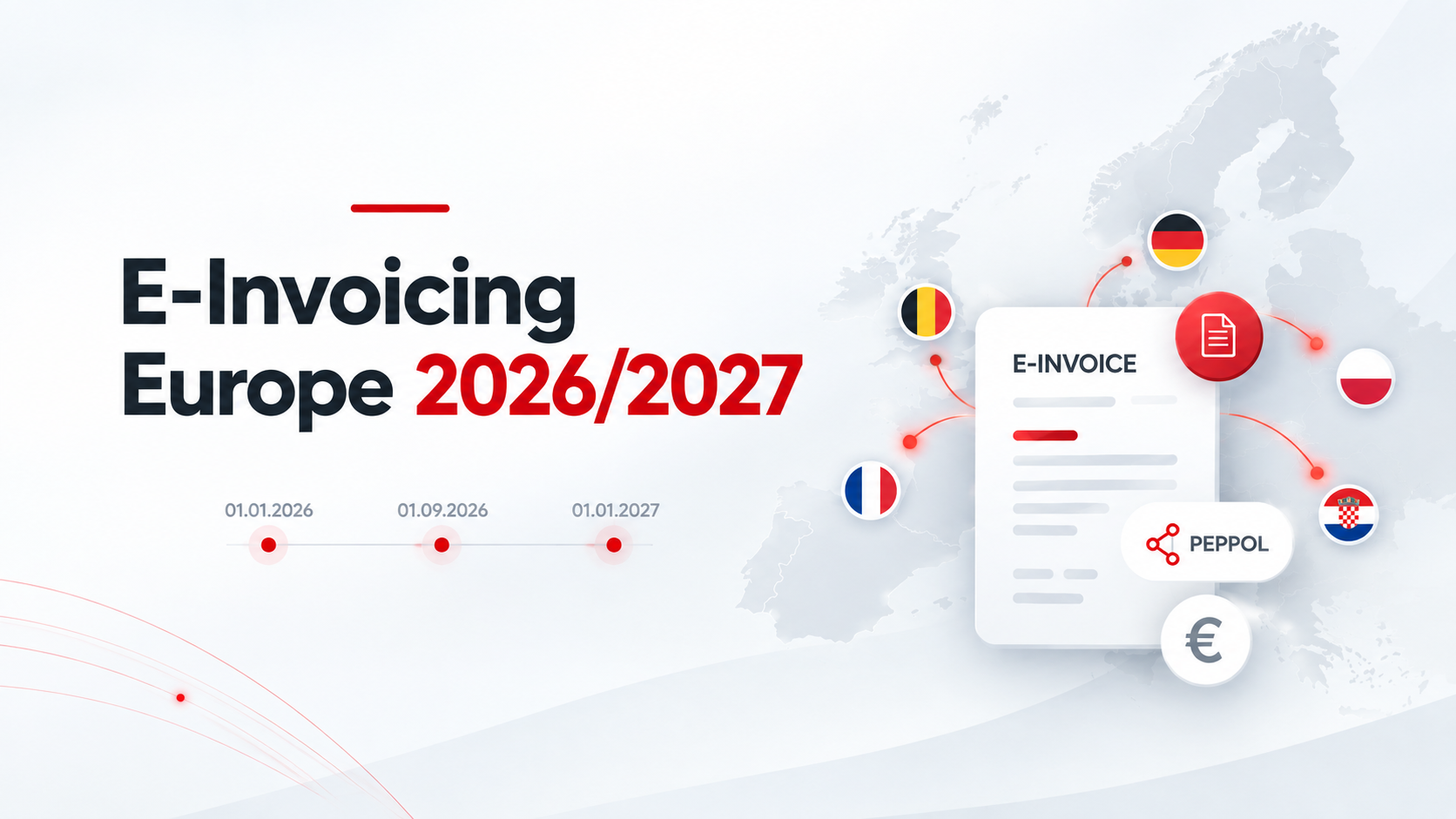
The most important e-invoicing deadlines for 2026/2027
E-invoicing in Europe continues to gain momentum. In 2026 and 2027, several European countries are introducing new e-invoicing mandates or expanding existing regulations. For internationally operating companies, it is therefore important to keep an eye not only on the respective deadlines, but also on the scope, required formats, transmission methods, and additional reporting obligations.
Last updated: 07 September 2026
01.01.2026 · Belgium
Since 1 January 2026, structured electronic invoices have been mandatory for almost all domestic B2B transactions between Belgian VAT-registered businesses. Exceptions include certain non-resident businesses without a fixed establishment in Belgium and businesses that exclusively carry out VAT-exempt transactions.
The standard exchange takes place via the Peppol network and generally using the Peppol BIS format. Other transmission methods or structured formats may be used if both business partners agree and the format used complies with the European standard for electronic invoicing.
Mandatory e-reporting is currently not part of the Belgian regulations in force since 2026. Near-real-time reporting is planned from 2028; however, the specific legislative implementation has not yet been finalized.
01.01.2026 · Croatia
Since 1 January 2026, businesses established in Croatia and registered for VAT must issue and receive structured e-invoices for domestic transactions. Businesses that are not VAT-registered have been required to be able to receive e-invoices since 2026. From 1 January 2027, the obligation to issue e-invoices will also be extended to them.
A distinctive feature of the Croatian model is Fiscalization 2.0. Defined data from the e-invoice is transmitted to the Croatian tax administration by both the issuer and the recipient. Additional e-reporting obligations also apply, for example for rejected or paid invoices or in certain cases where no e-invoice could be issued.
01.02.2026 and 01.04.2026 · Poland
With the Krajowy System e-Faktur (KSeF), Poland relies on a centralized government e-invoicing system. The mandatory issuance of invoices via KSeF was introduced in stages during 2026.
Since 1 February 2026, the issuance requirement has applied to companies whose gross revenue, including VAT, exceeded PLN 200 million in 2024. Since 1 April 2026, it has generally also applied to all other companies. Receiving invoices via KSeF has been mandatory since 1 February 2026.
A transitional arrangement remains in place for the smallest businesses: if the monthly gross turnover documented by invoices issued outside KSeF does not exceed PLN 10,000, these invoices may continue to be issued outside KSeF until the end of 2026. From 1 January 2027, this exemption will no longer apply.
KSeF is not merely a reporting system. Structured invoices are issued directly through the government system and receive a unique KSeF number. Under the standard online procedure, an invoice is generally considered issued on the date it is submitted to KSeF. For companies, this means above all that ERP, accounting, or EDI systems must be technically connected to KSeF.
01.09.2026 · France
On 1 September 2026, the phased introduction of mandatory e-invoicing begins for large companies and intermediate-sized enterprises, known as ETIs. Small and medium-sized enterprises and micro-enterprises will be required to issue electronic invoices from 1 September 2027.
However, the obligation to receive structured e-invoices already applies from 1 September 2026 to all businesses established and subject to VAT in France.
Invoices must be transmitted via a platform approved by the French tax authorities, either directly or through a compatible solution. E-reporting will also be introduced according to the same phased schedule. Certain transaction and payment data that is not already fully captured through the e-invoice will be transmitted to the French tax authorities.
01.01.2027 · Germany
Since 1 January 2025, all domestic businesses have been required to be able to receive structured e-invoices. Until 31 December 2026, all invoice issuers may still make use of the general transitional arrangement and, for example, issue paper or PDF invoices. This general transition period ends on 1 January 2027. Invoice issuers with previous-year turnover exceeding €800,000 must therefore generally issue structured e-invoices for domestic B2B transactions.
For invoice issuers with previous-year turnover of no more than €800,000, the transition period is extended until 31 December 2027. From 1 January 2028, structured e-invoicing will generally be mandatory for all domestic B2B transactions. Exceptions include low-value invoices of up to €250, transport tickets, and services provided by small businesses within the meaning of Section 19 of the German VAT Act (UStG). Although small businesses are exempt from the obligation to issue e-invoices, they must still be able to receive them.
Permitted formats include, in particular, formats compliant with EN 16931, including XRechnung and suitable versions of ZUGFeRD. No specific transmission method is prescribed. The introduction of e-invoicing also creates the technical basis for a transaction-based reporting system planned for the future.
01.01.2027 · Slovakia
On 1 January 2027, Slovakia will introduce a national transitional model for mandatory e-invoicing and electronic reporting of invoice data. This transitional model is scheduled to remain in place until 30 June 2030.
The obligation to issue e-invoices initially applies to domestic VAT-registered businesses supplying goods or services to another taxable person established in Slovakia or to a non-taxable legal entity established there. This covers both B2B and relevant B2G transactions. Exceptions include certain VAT-exempt supplies, simplified invoices of up to €100 including VAT, and eKasa receipts.
In practice, Slovakia relies on Peppol BIS and certified delivery service providers. Acting as a kind of “digital postman,” these providers handle the secure sending and receiving of invoices via the Peppol network.
In addition, legally required invoice data is reported to the Slovak Financial Administration via the delivery service. Since the issuer, the issuer’s access point, the recipient, the recipient’s access point, and the Financial Administration are all involved, the architecture can technically be described as a 5-corner model.
01.01.2027 and 01.07.2027 · Spain
In Spain, a distinction must be made between the requirements for invoicing systems and the separate general B2B e-invoicing obligation.
By 1 January 2027, corporate taxpayers using computerized invoicing systems must adapt their systems to the Spanish SIF requirements. For other affected taxpayers—including self-employed individuals carrying out economic activities, certain non-resident businesses with a permanent establishment, and other types of businesses—the deadline is 1 July 2027.
Companies that are required to maintain their VAT ledgers through the Suministro Inmediato de Información (SII) are only exempt from the requirement to transmit SIF records in real time. However, they must still use a tamper-proof invoicing system.
Important: VERI*FACTU is not automatically mandatory for all affected companies. VERI*FACTU refers only to the option under which all invoice records are continuously, automatically, and immediately transmitted to the Spanish tax authority, AEAT. Alternatively, companies may use a compliant system without continuous transmission that stores the data locally in accordance with legal requirements.
01.01.2027 · Norway
From 1 January 2027, businesses and organizations subject to bookkeeping requirements must issue electronic invoices for domestic B2B transactions if the invoice recipient is registered in the national recipient register (ELMA). The Norwegian Parliament adopted the corresponding amendments to the Bookkeeping Act in June 2026.
The e-invoice must be provided in a structured electronic format that enables automated processing. The specific invoice formats and exemptions that will apply are to be further defined by supplementary regulations.
A longer transition period applies to the receipt and automated processing of e-invoices. By 1 January 2030, businesses must use a digital accounting system capable of automatically receiving and processing electronic invoices. The Norwegian Ministry of Finance has explicitly announced corresponding transitional arrangements for the receiving obligation until 2030.
This makes Norway’s timeline different from that of many other countries: mandatory issuance begins as early as 2027, while the comprehensive requirement for digital processing on the recipient side will not take effect until 2030.
Other countries & challenges
Other countries are also working on comparable models or have already announced them. Requirements may differ in terms of:
- Transmission methods
- Validation rules
- Archiving requirements
- Reporting obligations
- Technical platform requirements
What is needed is a flexible structure capable of accommodating country-specific requirements.
How we support you as an EDI Service Provider
As an EDI Service Provider, we support companies in implementing international e-invoicing requirements.
Our services include:
- Analysis of country-specific requirements
- Integration of XRechnung, ZUGFeRD, and additional e-invoicing formats
- Conversion between existing EDI formats and national e-invoicing standards
- Integration with national platform models (e.g., France or Italy)
- Validation and monitoring of invoice processes
- Ensuring stable, compliant, and audit-proof operations
Further information:
- European Commission: eInvoicing Country Factsheets
We are always happy to assist you.